A Practical Guide to the Full Lifecycle Maintenance of Tension Leveler Work Rolls
——-A Technical Summary Based on Ten Years of Experience as Head of Maintenance
Author: Zhang, Head of Maintenance Department
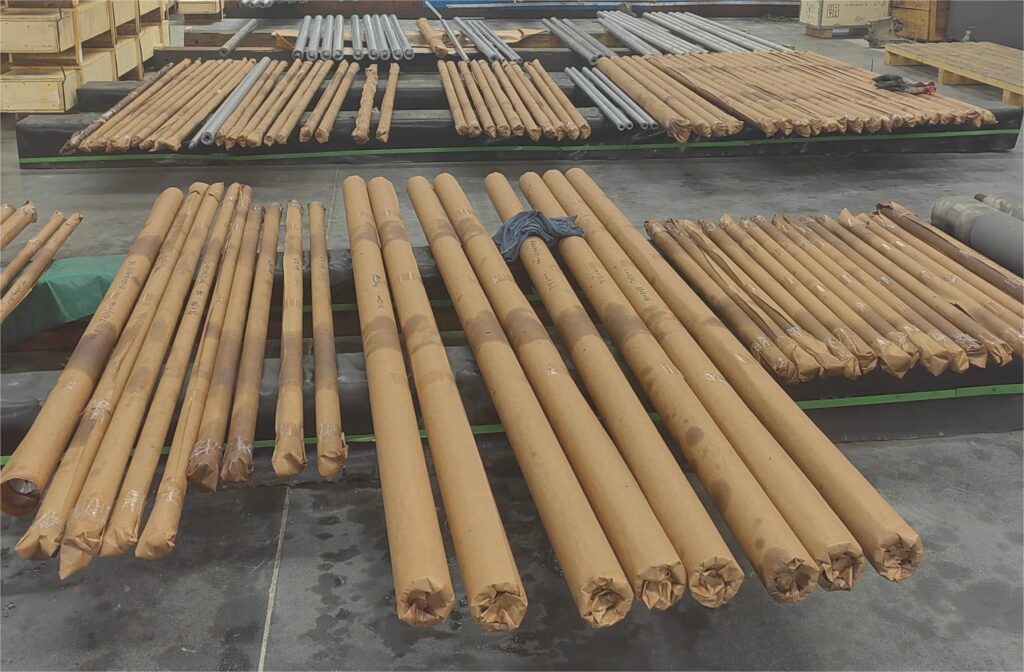
In the field of metal strip finishing, the tension leveler is the core equipment that determines strip shape quality. The work rolls (especially the intermediate rolls and backup rolls), as the “teeth” of the tension leveler, directly affect the strip’s flatness, surface quality, and the stability of equipment operation.
In recent years, as domestic metallurgical equipment maintenance technology has matured, an increasing number of production lines from overseas manufacturers (such as SMS, Danieli, Andritz, and other brands) are sending their tension leveler work rolls back to China for maintenance. This presents both opportunities and challenges. As the head of the maintenance department, I have led the repair of over 500 sets of imported tension leveler work rolls over the past decade, a significant portion of which were “return units” from overseas clients. Today, I will share a set of practical maintenance experiences from four dimensions: material differences, on-site management, process challenges, and quality control, aiming to provide technical support for peers engaged in this type of cross-border service trade.
I. Precise Diagnosis Before Maintenance of Tension Leveler Work Rolls: Establishing Equipment Records
The core of service trade is “reliability.” For foreign leveler rolls sent back to China for repair, we cannot start disassembly blindly. The first step must be reverse engineering, measurement, and record creation.
Original Parameter Collection Foreign equipment typically has smaller design margins. Before maintenance, the following data must be clarified:
Roll Arrangement: Is it a 2-bend/2-straightener or 1-bend/2-straightener configuration? What is the roll diameter tolerance (typically controlled within ±0.005mm for foreign rolls)?
Material Identification: This is paramount. Imported roll bodies are typically made of High-Speed Steel (HSS), powder metallurgy steel, or cold-work tool steel. A portable spectrometer must be used to confirm the material. It must never be mixed up with domestic materials, as this would completely compromise the heat treatment process.
Failure Mode Analysis: Is it fatigue spalling, surface pick-up (sticking), excessive wear, or bearing seat wear? Different failure modes require completely different maintenance plans.
Pre-treatment Before Cross-Border Shipping Before overseas rolls are shipped, it is recommended that clients perform rust prevention treatment and document the original damage condition. Upon receipt in China, we immediately conduct a re-inspection and confirm with the client to avoid disputes arising from secondary damage during transport.
II. Material Differences: A “Genetic” Comparison Between Domestic and Oversea Work Rolls
Before formulating a Maintenance of Tension Leveler Work Rolls plan, it is crucial to understand the roll’s “genetics”—its material. Domestic tension leveler work rolls (especially those from early designs or localized production lines) commonly use 9Cr2Mo and GCr15, while mainstream foreign equipment tends to use High-Speed Steel (HSS), powder metallurgy steel, or alloy tool steels (such as the Cr12MoV series) . There are significant differences in physical properties, heat treatment characteristics, and failure modes between the two. Maintenance strategies must be tailored accordingly.
| Comparison Dimension | Common Domestic Materials | Common Foreign Materials | Impact on Maintenance Process |
|---|---|---|---|
| Representative Grades | 9Cr2Mo, GCr15 | HSS (e.g., M2), Powder Metallurgy Steel (e.g., Vanadis 4), Cr12MoV | The material determines the heat treatment process window and repairability. |
| Hardness Characteristics | 9Cr2Mo: Tempered hardness approx. HRC 60-65 GCr15: Good hardenability, hardness HRC 60-64, but poor hot hardness (hardness drops sharply at high temperatures) | HSS: Can reach HRC 64-68, with excellent red hardness (maintains high hardness at 600°C) Powder Metallurgy Steel: Uniform structure, no segregation, extremely strong fatigue resistance | Domestic materials are more prone to surface softening and pick-up caused by frictional high temperatures under high-speed, heavy-load conditions; foreign materials tend to exhibit fatigue spalling or micro-cracks. |
| Toughness Performance | GCr15: Average impact toughness, sensitive to notches 9Cr2Mo: Relatively better toughness, but insufficient wear resistance | Powder Metallurgy Steel: Combines high hardness and high toughness, excellent impact resistance HSS: Toughness lower than powder metallurgy steel, but better than GCr15 | Stricter non-destructive testing standards are required for domestic materials during maintenance. They have a lower tolerance for micro-cracks, which can easily propagate under stress, leading to roll breakage. |
| Heat Treatment Process | Typically uses overall quenching + low-temperature tempering. Hardened layer depth is usually 2-5mm. | Often uses surface induction hardening or overall vacuum quenching + multiple tempering. Deeper hardened layer with a gradual transition zone. | During maintenance grinding, the fatigue layer must be completely removed for domestic materials; any remaining softened layer will lead to rapid failure. |
| Accident Resistance | Sensitive to abnormal conditions like “slippage” or “pick-up,” prone to surface burns or roll surface scoring. | Strong surface coating or hardened layer adhesion; better resistance to abnormal wear. | For domestic materials, it is recommended to add hard chrome plating or PVD coating after maintenance to compensate for the substrate’s inherent lack of wear resistance. |
Direct Impact on Cross-Border Maintenance Strategy:
Different Scrap Judgment Criteria For foreign powder metallurgy steel work rolls, the internal structure is uniform, and they have a higher tolerance for micro-defects. They can often continue to be used after removing surface defects through precision grinding. Conversely, if encountering domestic GCr15 material rolls (used in some older mixed production lines), the non-destructive testing standards must be much stricter.
Differences in the Need for Coating Processes Original foreign rolls (especially HSS material) inherently possess excellent wear resistance. During maintenance, we can choose whether to restore the coating according to the original manufacturer’s process. However, for rolls with domestic substrate materials, we proactively explain to overseas clients during service trade: it is recommended to adopt a “substrate repair + hard chrome plating” or “HVOF tungsten carbide coating” as an upgrade process to compensate for the substrate’s lack of wear resistance. This is not just repair, but a performance upgrade.
Heat Treatment Restrictions For domestic GCr15 rolls, high-temperature flame spray welding to repair bearing seats is strictly prohibited. Foreign HSS rolls, due to their good red hardness, have a relatively higher tolerance for heat input, but careful control is still necessary.
Summary: In cross-border service trade, when dealing with overseas equipment owners, we must clearly communicate that maintenance plans for domestic and foreign materials cannot simply be “copied.” For original foreign rolls, we adhere to the principle of “restoring original geometric precision, matching original coating performance, and full lifecycle traceability.” This differentiated, professional technical communication is precisely the core value we offer as a maintenance service provider.
III. Core of Tension Leveler Work Rolls Processes: Four Key Control Points
Maintaining tension leveler work rolls is not simply about “grinding and plating.” Overseas clients place the highest importance on roll geometric accuracy and restoration of surface physical properties. This is especially critical when rolls are sent back to China for cross-border repair—process stability and traceability directly determine client repurchase intent.
1. Descaling and Non-Destructive Testing (NDT)
Imported rolls typically have a hard chrome or hardened layer on the surface.
Operation: The fatigue layer must first be removed using a lathe. Do not proceed directly to a grinder; otherwise, the expensive grinding wheel will wear out quickly due to the hard layer.
NDT: After surface layer removal, Magnetic Particle Testing (MT) and Ultrasonic Testing (UT) must be performed. If internal micro-cracks extending beyond the allowable depth are found (the allowable residual crack depth typically does not exceed 5% of the remaining wall thickness), the roll must be scrapped. In cross-border service trade, proactively providing clients with a bilingual (Chinese-English) NDT report is the first step in building trust.
2. The “Balancing Act” of Surface Hard Chrome Plating and Hardness
Oversea tension levelers have extremely high requirements for the coefficient of friction.
Process Selection: For work rolls with a diameter less than 60mm, I recommend using a hard chrome plating process. Note that original foreign rolls often utilize a “matte chrome + hard chrome” double-layer plating.
Hardness Control: Hardness must reach HV 900-1100, with uniformity deviation not exceeding ±50 HV.
Adhesion: This is the biggest challenge in repair. If coating adhesion is insufficient, it can peel off within minutes of operation. Our experience dictates using reverse current etching to activate the surface and strictly controlling the bath temperature (55±2°C) to ensure a metallurgical bond between the coating and the substrate.
Alternative Process: For high-strength steel production lines, traditional hard chrome plating may lack sufficient wear resistance. We have introduced High-Velocity Oxygen Fuel (HVOF) thermal spraying of tungsten carbide. Although the cost is higher, the service life is 3-5 times that of hard chrome plating, representing a profit growth area in high-end service trade.
3. Precision Repair of Bearing Seats and Ends
Tension levelers generate significant vibration, making bearing seat wear a common issue.
Brush Plating and Build-up Welding: For bearing seat wear, avoid directly applying build-up welding without subsequent heat treatment. Tungsten Inert Gas (TIG) cold welding or electro-brush plating techniques must be used, strictly controlling the interpass temperature (below 80°C) to prevent roll body deformation.
Concentricity: The concentricity of the repaired bearing seat relative to the roll body must be ≤0.01mm. We use high-precision cylindrical grinders to complete the grinding in a single setup. This is key to ensuring the tension leveler does not produce periodic chatter marks during high-speed operation.
4. The “Subtlety” of Roll Profile
Many repair shops overlook this: foreign tension leveler work rolls are not standard cylinders; they have specific crowns or sinusoidal curves.
During the grinding stage, a CNC grinder must be used to restore the CVC (Continuous Variable Crown) curve or specific chamfers according to the original drawings.
Inspection: Use a profilometer to output the roll profile graph as a deliverable. Grinding it into a perfectly straight cylinder would instead cause center buckles or edge waves in the strip during operation—a classic case of “fixing the hardware but breaking the software.”
IV. The “Soft Power” of Service Trade: Delivery and Traceability
As a maintenance department engaged in cross-border service trade, we are not just selling repaired rolls; we are selling the ability to “solve problems.” Overseas clients cannot supervise the process on-site, making process transparency and delivery standardization paramount.
Digital Delivery Each set of repaired work rolls must be accompanied by a detailed Maintenance Quality Report, ideally in both Chinese and English, including:
Original damage photos (proof of necessity for repair).
NDT report (proof of substrate integrity).
Coating thickness measurement (multiple points measured with a micrometer; typically controlled at 0.05-0.08mm).
Surface roughness (Ra value controlled between 0.2-0.4μm; too smooth causes slippage, too rough scratches the strip).
Paired Management and Traceability System Tension levelers usually operate with paired top and bottom rolls. Our practice is: number and manage the rolls, establishing a full lifecycle archive.
Each roll is assigned a unique ID, recording the grinding amount, coating parameters, and NDT results for each maintenance cycle.
Typically, imported rolls can be repaired 3-5 times (with each grinding amount controlled to 0.1-0.2mm per side). When the roll diameter wears down to the limit, the client must be advised to scrap it. In service trade, proactively reminding the client that “this roll is approaching the end of its service life” demonstrates responsibility and builds long-term trust.
Emergency Response and Spare Roll Mechanism The cost of downtime on overseas production lines is extremely high. In cross-border service trade, we commit to “24-hour response, efficient turnaround.”
Establish a spare roll pool for common specifications. While the client’s rolls are sent back to China for repair, we can coordinate the temporary use of spare rolls, or adopt a “replacement during repair” model to shorten the client’s waiting period.
Clearly communicate the maintenance lead time (typically 15-30 working days, including logistics) and adhere to it strictly. This is a crucial indicator of service trade execution capability.
V. Conclusion
Sending foreign tension leveler work rolls back to China for repair is a test of our technical capabilities and a reflection of our competitiveness in the service trade.
As the head of the maintenance department, I believe successful cross-border maintenance services rely on three points:
Technical Benchmarking: Fully understand foreign original drawings and material standards, clearly identify domestic vs. foreign material differences, and achieve post-repair performance not inferior to original parts (OEM standards).
Process Transparency: Transform invisible quality aspects like NDT, coating hardness, and roll profile into visualized, bilingual data reports, giving overseas clients “remote peace of mind.”
Full Lifecycle Management: Evolve from single repair services to a closed-loop system encompassing “diagnosis, repair, spare rolls, early warning, and traceability,” helping clients reduce their total cost of ownership.
Only when we treat every repaired work roll as a precision instrument can our service trade earn respect and long-term orders in the international market.
Note: The specific process parameters mentioned in this article, such as hardness values, temperatures, and grinding amounts, should be adjusted based on your company’s actual equipment capabilities and client operating conditions. This article is for reference purposes only.