
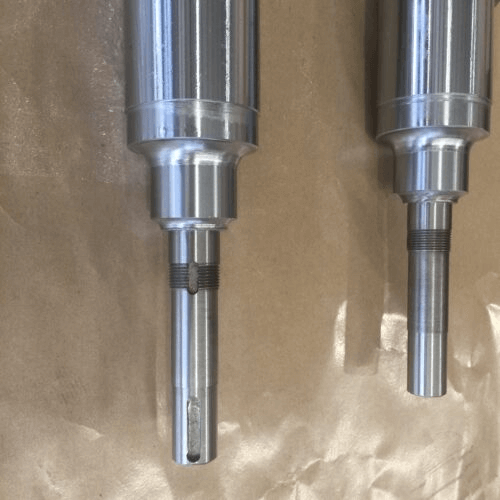
Mill Roll for cold rolling mills in Metallurgical industry
Introduction of Mill Roll
Mill roll is a critical, consumable tool used in metal rolling mills to plastically deform metal stock (such as billets, slabs, or strips) by passing it through one or more pairs of rolls. They are the core components that directly apply pressure to reduce thickness, shape the cross-section, and impart desired mechanical and surface properties to the metal product. The performance and quality of the rolls directly determine the efficiency, product precision, and operational cost of the entire rolling process.
Rolls are subjected to extreme conditions, including high cyclic mechanical stress, severe wear, thermal fatigue from hot metal contact, and in some cases, corrosion. Therefore, their design, material selection, and manufacturing are fields of specialized metallurgical engineering.
Classification & Types of Mill Roll
Rolls can be classified based on several criteria:
| Classification Basis | Main Types | Brief Description & Typical Use |
|---|---|---|
| By Mill Process | Hot Rolling Rolls | Used above metal’s recrystallization temp. Must withstand thermal shock, scale abrasion. Materials: Adamite Nodular Graphite Iron, High-Cr Iron/Steel, High-Speed Steel (HSS). |
| Cold Rolling Rolls | Used at room temp. Require ultra-high hardness, fine surface finish. Materials: Forged alloy steel (e.g., 86CrMoV7), hardened to high HS/HRC. | |
| By Position/Function | Work Rolls | Directly contact the metal. Smaller diameter, highest surface and precision requirements. |
| Back-up / Support Rolls | Support work rolls to prevent bending. Larger diameter, require high strength and toughness. | |
| Intermediate Rolls | Used in 6-high mills between work and backup rolls for enhanced shape control. | |
| By Material | Cast Iron Rolls | Includes indefinite chill, nodular graphite, and high-chromium iron. Good wear resistance, widely used in hot roughing/intermediate stands. |
| Forged Steel Rolls | Superior strength and toughness. Used for cold work rolls, hot finishing stands, and backup rolls. | |
| Sintered / Composite Rolls (e.g., HSS, Tungsten Carbide) | Extremely hard and wear-resistant. Used in demanding finishing stands for high-value products. |
Key Material Characteristics:
Cast Iron Rolls: Offer good thermal shock resistance and natural lubricity from graphite. High-Chromium Iron (Hi-Cr) rolls provide excellent wear and corrosion resistance.
Forged Steel Rolls: Provide the best combination of toughness, strength, and homogeneity. Essential for high-load and precision rolling.
High-Speed Steel (HSS) Rolls: Contain carbides of vanadium, tungsten, molybdenum. Offer exceptional wear resistance, extending service life in hot finishing mills.
Core Technical Parameters & Design
The engineering of a mill roll revolves around several key parameters:
Roll Diameter and Barrel Length: Defines the maximum width of the product and influences roll stiffness, contact area, and specific pressure.
Roll Crown: A deliberate convex profile ground onto the roll barrel to compensate for deflection under load, ensuring flat product output.
Material & Hardness: Selected based on mill position and process. Hardness is often graded, with the surface being hardest and the core tougher.
Surface Finish: Critical for cold rolls, which require a mirror-like finish (Ra < 0.2 µm) to transfer to the strip. Hot rolls have a rougher, textured finish for scale breaking.
Internal Quality: Requires sound metallurgy, free from harmful inclusions, porosity, or residual stresses that could lead to spalling or breakage.
Primary Industrial Applications
Mill rolls are indispensable across the entire spectrum of metal forming:
1. Steel Industry
Flat Product Rolling:
Slabbing, Hot Strip Mills: Large-diameter cast iron or composite rolls for roughing. HSS rolls are dominant in finishing stands for strip production.
Cold Rolling Mills: Ultra-hard forged steel work rolls for tandem mills and temper mills producing sheet, strip, and tinplate.
Long Product Rolling:
Blooming, Billet, Bar, and Wire Rod Mills: Cast iron or forged steel rolls with precisely machined grooves (calibrations) shape the cross-section into rounds, squares, angles, rails, etc.
Section & Profile Mills: Specialized groove designs on rolls produce complex structural shapes like I-beams and channels.
2. Non-Ferrous Metal Industry
Aluminum & Copper Hot/Cold Rolling: Similar to steel but often at lower forces. Forged steel rolls are standard, with premium alloys used for finish rolling of foil (down to 0.006mm thickness).
3. Specialized Applications
Skin Pass / Temper Rolling: Uses very hard, polished rolls to impart a slight final reduction (<5%) to improve metallurgical properties and surface texture.
Foil Rolling: The pinnacle of roll technology, requiring micron-level precision, perfect surface finish, and extreme rigidity.
Maintenance & Lifecycle Management
Roll management is a critical cost center for mills:
Regrinding: Rolls are periodically removed and reground on dedicated roll grinders to restore surface finish, crown, and diameter, and to remove fatigue cracks.
Condition Monitoring: Tracking tonnage rolled, incidents, and wear patterns for each roll enables predictive maintenance.
Roll Shop: A modern mill has a sophisticated roll shop equipped with grinding, ultrasonic testing, and heat treatment facilities.
Future Trends & Conclusion
The evolution of mill rolls focuses on:
Advanced Materials: Development of new composite materials, nano-structured alloys, and improved HSS grades for longer life and higher performance.
Smart Rolls: Integration of embedded sensors for real-time monitoring of temperature, stress, and vibration during operation.
Precision Manufacturing & Coatings: Use of laser cladding for localized repair and advanced physical vapor deposition (PVD) coatings to enhance wear resistance.
Conclusion: The mill roll is far more than a simple tool; it is a high-precision engineered component whose technology continuously advances to meet the demands for higher productivity, superior product quality, and reduced operational costs in metal rolling. Its development remains at the forefront of metallurgy, materials science, and mechanical engineering, truly serving as the “heart” of the rolling process.