Electrical and automotive component manufacturing imposes stringent flatness requirements on ultra‑thin copper strip. Even minor local waviness, edge wave or camber defects on 0.08‑1.0 mm copper strip will trigger fatal risks during subsequent stamping, etching and welding processes for busbars, battery connectors and automotive wiring components. As documented in flat‑rolling technical literature, multi‑roll stretch levelling addresses these challenges by combining mechanical alternating bending and local roll‑crown compensation to homogenize residual stress across the full strip width. The 23‑roll stretch leveler is purpose‑built to deliver consistent flatness correction for thin‑gauge copper strip for high‑end electrical system production.
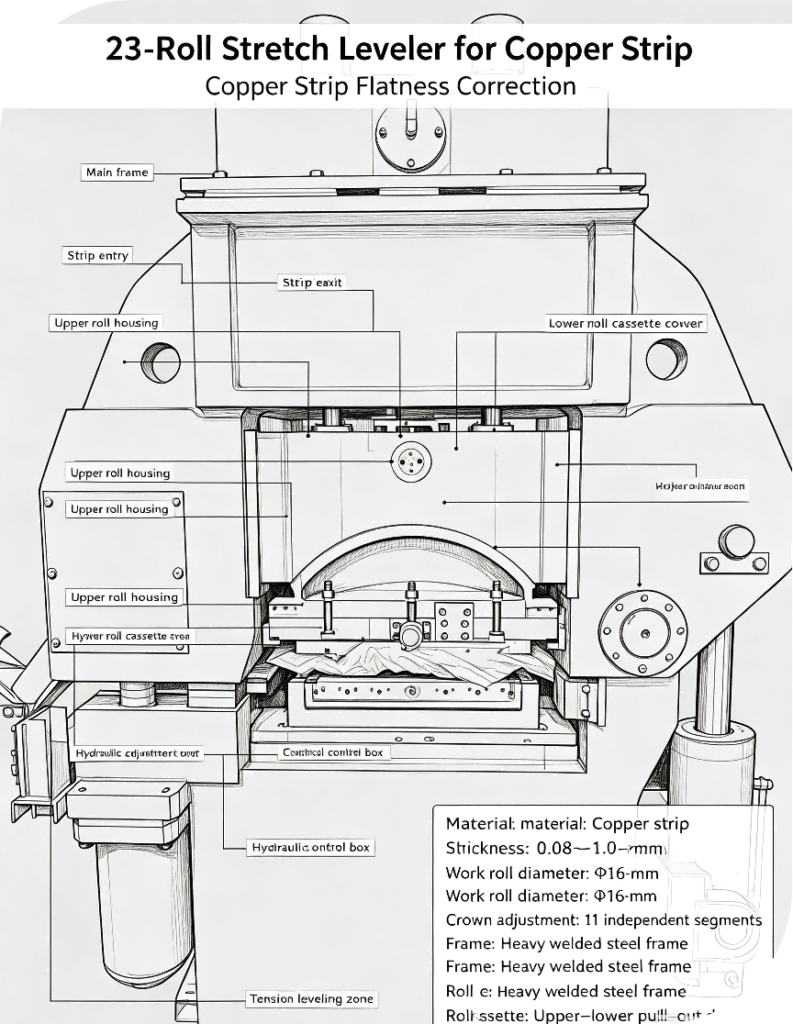
1.Working Principle for23‑Roll Stretch Leveler
For thin copper strip ranging from 0.08 mm to 1.0 mm thickness, conventional 5‑roll or 7‑roll levelers cannot generate enough micro‑plastic deformation to eliminate latent residual stress. The 23‑roll stretch leveler adopts staggered‑arranged small‑diameter work rolls to subject incoming copper strip to repeated alternating bending. According to metallurgical flatness‑control theory, successive small‑amplitude bending cycles redistribute uneven longitudinal elongation over the strip surface, removing centre wave, edge wave and camber without over‑stretching or material thinning.
Before strip feeding, operators pre‑set roll gaps and roll crown values based on incoming copper strip thickness and incoming flatness condition. As copper strip passes through the roll cassette, 11 upper work rolls and 12 lower work rolls perform cyclic flexing. Eleven independent servo‑hydraulic cylinders drive inclined‑block mechanisms for segmented lower back‑up roll crown adjustment. This segmented crown compensation capability is critical for ultra‑thin copper: each zone can be fine‑tuned to counteract local flatness deviations common in cold‑rolled copper coil.
2.Mechanical Construction & Key Technical Parameters
The main frame of this 23‑roll stretch leveler is heavy‑duty open‑type welded construction fabricated from Q235A steel plate. After plasma cutting and continuous welding, the complete frame receives overall electric‑furnace stress‑relief annealing, followed by finish‑machining on a 10‑meter CNC boring‑milling centre. Frame opening‑closing positioning uses taper pins with cylinder‑driven locking and proximity‑switch safety interlock, protecting operators during roll‑cassette change‑out procedures.
The pressing mechanism uses a 3 kW motor‑reducer unit driving a worm‑gear set; the pressing screw translates vertical movement to the upper roll assembly without rotation. A separate motor‑driven swing mechanism with eccentric shaft imparts fine deflection angle adjustment for the upper roll housing.
Roll system configuration:
Work‑roll quantity: 23 total staggered work rolls (11 upper,12 lower), roll diameter Φ16 mm
Intermediate rolls:25 pieces
Bearings: imported INA / FAG roller bearings
Roll material: Cr12MoV, surface quenched HRC 64‑66, quenching depth 2.0‑2.5 mm
Crown adjustment: 11 independently adjustable segments via servo‑hydraulic cylinders
Roll cassette: complete upper‑lower levelling roll cassette, pull‑out simultaneous replacement for rapid maintenance
Work rolls, intermediate rolls adopt Cr12MoV tool steel with deep surface quenching. For thin soft copper strip, high surface hardness avoids roll surface indentations that would downgrade electrical‑grade copper strip surface quality. The full upper‑lower roll cassette can be pulled out simultaneously, shortening roll‑change downtime during coil grade change‑over.
- Actual Industrial Application Scenarios
Electrical component manufacturing remains the primary application field for the 23‑roll stretch leveler. Cold‑rolled copper strip processed on this equipment serves busbars, electrical connectors, switch components for high‑voltage and low‑voltage electrical systems. Consistent strip flatness eliminates failures during high‑speed stamping and etching, lowering scrap rates for electrical copper parts.
Beyond electrical copper processing, this multi‑roll levelling equipment fits automotive manufacturing workflows. Thin copper strip for automotive wiring harness terminals, vehicle body conductive components can be precisely levelled. It also supports home‑appliance production: copper strip for refrigerator internal conductive parts, air‑conditioner electrical assemblies benefit from homogenized residual stress after levelling treatment.
The same mechanical principles apply for selected thin‑gauge steel strip processing for transportation infrastructure projects. While the machine is optimized for 0.08‑1.0 mm copper strip, it can handle equivalent thin metallic strip for metro, tram and airport transport‑hub component production.
For modern metal‑processing workshops, rapid roll cassette exchange and segmented hydraulic crown adjustment deliver tangible operational advantages. Journal publications on multi‑roll levelling point out that segmented roll‑crown compensation significantly improves finished flatness consistency for wide, ultra‑thin soft metal strips compared to fixed‑crown roll systems. The 23‑roll stretch leveler integrates these proven technical features into one compact unit for copper‑strip processors.
Conclusion
For manufacturers processing 0.08‑1.0 mm copper strip for electrical and automotive industries, stable flatness correction and residual‑stress homogenization directly determine end‑product yield. With staggered Φ16 mm work‑roll layout, eleven‑segment servo‑hydraulic crown adjustment, heavy annealed welded frame and quick‑change roll cassette, the 23‑roll stretch leveler delivers repeatable levelling performance for high‑grade copper coil production.
If you are evaluating multi‑roll levelling equipment for your copper‑strip processing line, contact our engineering team for technical parameter matching and project‑specific solution confirmation.
- Topics You may Be Interested In:
- Multi-roll Leveler
- Work Roll
- Roll cassettes
- Back up roll
- Roll coater