- Cylindrical Roller Bearings Introduction
Metallurgical production lines including hot rolling, cold rolling, continuous casting, levelers and rotary shearing equipment operate under extremely demanding conditions: heavy radial load, frequent impact shock, thermal expansion‑induced misalignment, cooling water and scale contamination, plus long‑term continuous 24‑hour running.
Standard stock cylindrical roller bearings often suffer premature failure: fatigue spalling, cage fracture, roller edge chipping and unexpected production shutdown.
Our metallurgy‑grade cylindrical roller bearings (NU, NJ, N, NUP series) are purpose‑optimized for rolling mill auxiliary shafts, leveler rolls, shear drive shafts and roller table applications. This article clarifies model distinctions, key dimensional ranges, core strengths and proper application matching, illustrating how our customized bearings outperform standard general‑purpose bearings.
- Main Series, Dimensional Scope & Structural Characteristics
All dimensions reference bore diameter; specialized bearings sizes available for retrofitting existing mill equipment.
- NU Series (NU200, NU2200, NU2300)
- Bore size range: 40 mm ~ 450 mm
- Structure: Separable outer‑ring guided rollers, no axial location capacity; inner ring and roller assembly can be installed independently.
- Core feature: Accommodates free axial displacement between shaft and housing, absorbs thermal elongation of mill rolls.
- Best‑fit metallurgical equipment: Hot mill roller tables, auxiliary transmission shafts, intermediate rolls subject to large thermal expansion.
- NJ Series (NJ200, NJ2200, NJ2300)
- Bore size range: 40 mm ~ 420 mm
- Structure: Outer ring with one integral flange; permits limited one‑direction axial positioning.
- Core feature: Bears heavy radial load plus unidirectional moderate axial force. Simplifies bearing arrangement without extra thrust components.
- Best‑fit metallurgical equipment: Plate leveler shafts, rotary side trimmer drive ends, continuous casting driven rollers.
- N Series (N200, N2200, N2300)
- Bore size range: 50 mm ~ 480 mm
- Structure: Inner‑ring guided rollers; outer ring removable.
- Core feature: High radial stiffness, good for shafts where outer ring needs to float in housing bore.
- Best‑fit metallurgical equipment: Cold rolling mill auxiliary support rolls, finishing line transport rollers.
- NUP Series (NUP200, NUP2200, NUP2300)
- Bore size range: 45 mm ~ 400 mm
- Structure: Outer‑ring fixed flange plus loose snap‑on flange ring; provides bidirectional axial positioning.
- Core feature: Takes heavy radial load together with bidirectional axial loads, compact single‑bearing solution instead of paired bearing sets.
- Best‑fit metallurgical equipment: Reversing mill intermediate shafts, heavy‑duty shear main shafts subject to alternating axial thrust.
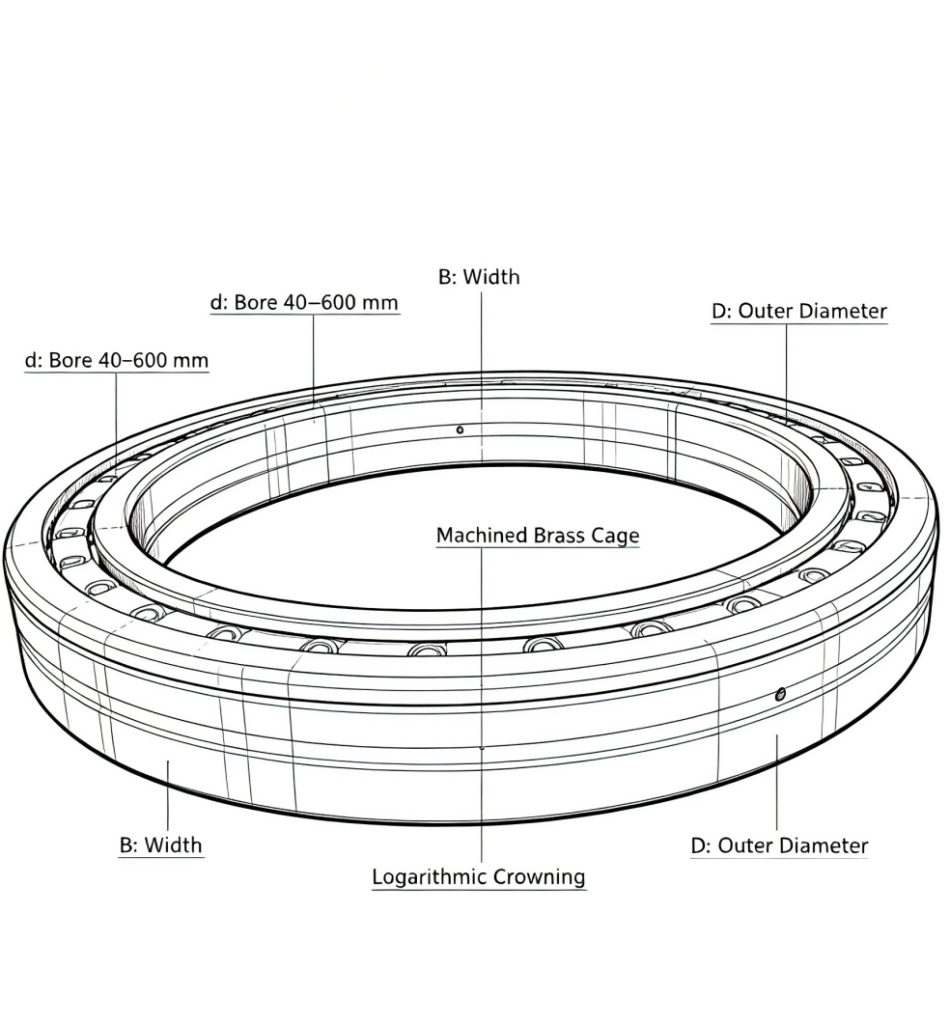
Clear note: Standard stock bearings mostly cover small‑to‑medium bore sizes. For metallurgical retrofits we supply oversized non‑standard cylindrical roller bearings bore up to 600 mm, tailored for heavy plate mill auxiliary drives.
- Our Metallurgy‑Grade Bearing Technical Advantages vs Ordinary Standard Cylindrical Roller Bearings
2.1 Optimized Roller Logarithmic Crowning
General‑purpose bearings adopt straight roller geometry. Under mill shaft deflection, load concentrates at roller edges and causes early edge spalling.
Our advantage: Precision logarithmic crowning profile machined on rollers. Stress distributes uniformly across full roller length under shaft misalignment (up to 5‑7 arc‑minutes). Effectively eliminates edge‑loading failure under heavy‑load metallurgical deflection.
2.2 High‑Performance Material & Heat Treatment
Ordinary bearings: Standard 100Cr6 through‑hardened steel, limited shock‑load tolerance.
Our advantage: Two material routes for metallurgy working conditions
Case‑carburized AISI 8620 / 20CrNi2Mo for shock‑prone positions: Surface hardness 58‑62 HRC, tough core resists cracking under impact; retained austenite controlled 12‑18 % for micro‑plastic shock absorption.
High‑quality through‑hardened 100Cr6 with dimension‑stabilized S1 heat‑treatment. Dimensional stability sustained under continuous operating temperature up to 130 °C; avoids clearance shrinkage from heat in hot‑mill environments.
2.3 Heavy‑Duty Brass Machined Cage
Standard light‑duty bearings often use stamped steel cages, prone to deformation and fracture under cyclic mill impact.
Our advantage: Solid machined brass cage, high rigidity and wear‑resistance. Prevents roller skewing under vibration and shock load, greatly raising service life for roller‑table and shear drive applications.
2.4 Custom Internal Clearance Selection
Off‑the‑shelf bearings default to C0 clearance. When hot mill shafts heat‑up and expand, insufficient clearance leads to bearing overheating and seizure.
Our advantage: We configure C3 / C4 radial clearance for hot‑running metallurgical positions, reserving allowance for thermal expansion. For cold‑mill low‑vibration requirement, C2 reduced‑clearance variants are available.
2.5 Surface Enhancement Option
Optional black‑oxide / DLC coating applied on rollers and raceways. Reduces micropitting risk when lubricant gets contaminated by iron fines and oxide scale — a very common failure source inside metallurgical equipment.
- Application‑Driven Model Selection Guidance for Metallurgical Plants
Table
| Bearing Series | Main Load | Key Capacity | Typical Metallurgical Equipment |
| NU Series | Pure heavy radial load | Free axial float for thermal expansion | Hot mill roller tables, intermediate rolls |
| NJ Series | Radial + one direction axial load | Unidirectional axial locating | Leveler shafts, rotary trimming shear drives |
| N Series | Heavy radial load | Outer ring floating capability | Cold mill support rolls, finishing transport rollers |
| NUP Series | Radial + bidirectional alternating axial load | Bidirectional locating with single bearing | Reversing mill shafts, heavy duty shear main shafts |
Field practical tips:
Hot working sites with obvious thermal elongation → Prioritize NU series to release axial displacement stress.
Where both heavy radial load and axial thrust occur: choose NJ or NUP instead of assembling standard bearing pairs, simplify structure and reduce installation‑induced preload error.
Impact‑heavy roller‑table environment: Specify machined brass cage + C3 clearance.
- Service‑Life Comparison: Our Metallurgy‑Grade vs Ordinary Standard Bearings
Under representative metallurgical working conditions (heavy radial load, intermittent shock, contaminated lubricant):
Ordinary general‑purpose cylindrical roller bearings: Typical service life 2 000‑4 000 hours, frequent spalling and cage damage.
Our optimized metallurgy‑grade cylindrical roller bearings: Field verified service life reaches 8 000‑15 000 hours, reducing bearing replacement frequency and unplanned mill downtime.
5.Conclusion
Hot rolling, cold rolling, continuous casting and finishing lines suffer heavy radial load, mechanical impact, thermal deformation and lubricant contamination. Ordinary off‑the‑shelf bearings cannot cope with these combined harsh conditions and cause frequent production stops.
Our NU / NJ / N / NUP series metallurgical‑grade cylindrical roller bearings adopt logarithmic roller crowning, case‑carburized or dimension‑stabilized steel, solid machined brass cages and application‑matched internal clearance. Whether for standard sizes or large‑bore non‑standard customisation up to 600 mm bore, they greatly extend L10 service life and cut total operating cost for steel mills.
When you select our metallurgical cylindrical roller bearings, you obtain bearing solutions engineered specifically for real‑world mill failure modes, not just general catalog specifications.
- Topics You may Be Interested In:
- Bearing
- Scrap chopper
- Tension Leveler
- Multi-roll Leveler
- Roll coater