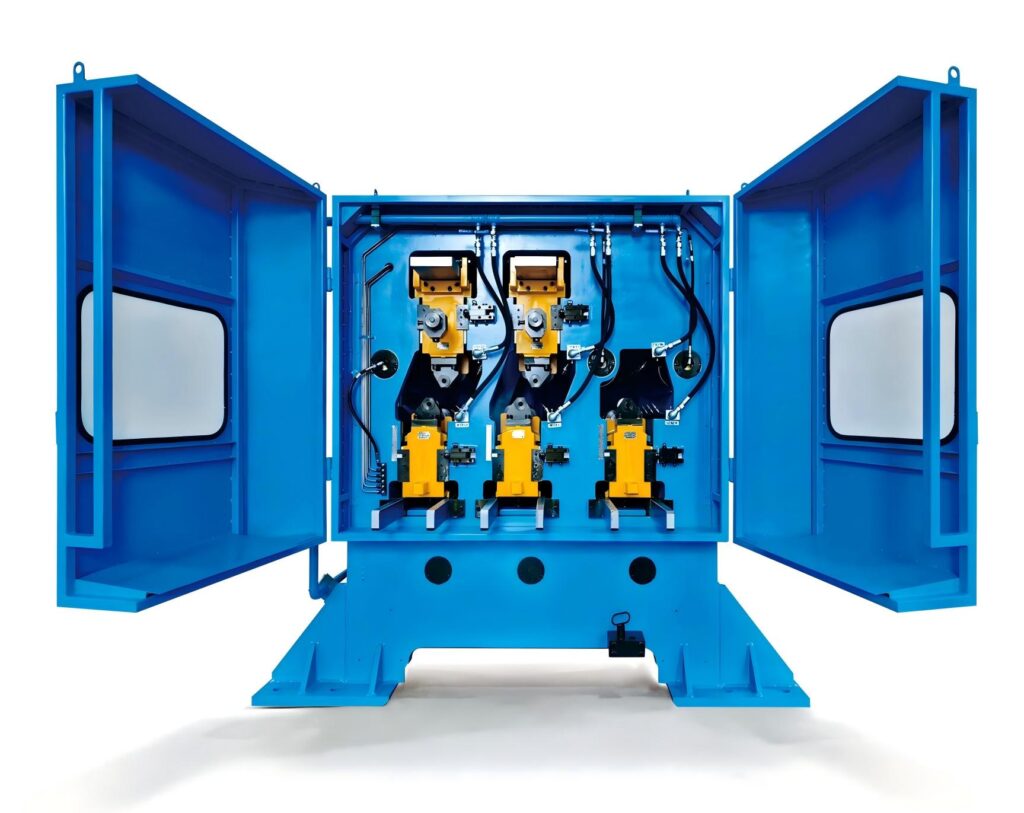
Scale Breakers Optimize Surface Quality Before Cold Rolling
1. The Rise of African Steel Processing: Why Push-Pull Pickling Lines Are the Preferred Choice
Africa’s steel consumption has been growing steadily, yet the continent has long relied on imported cold rolled finished products while its domestic downstream processing capacity remained underdeveloped. In August 2026, John Cockerill India secured a US$21 million order from Tanzania’s A1 Steel Company to supply a complete cold rolling and galvanising complex in Dodomaincluding a push pull pickling line and its critical front end equipment, the Scale Breaker.
This landmark project signals a clear trend: Africa’s emerging steel markets are moving beyond primary smelting toward high value added processing. Push-pull pickling lines are particularly suitable for these markets because they require lower capital investment, offer high flexibility in handling varying strip dimensions and grades, and are simpler to operate and maintainwith annual capacities reaching up to 1 million tonnes. However, the very first processing stepthe Scale Breaker – determines the efficiency of subsequent pickling and the final surface quality for cold rolling. More and more African mills now realise that without effective scale breaking, high quality cold rolled products remain out of reach.
2. Operating Principles and Types of Scale Breakers: Dry vs. Wet Selection
The core mechanism of a Scale Breaker lies in the coordinated action of bending rolls and tension rolls, which impose a controlled elastic elongation of 2% to 7% on the hot rolled strip. This mechanical deformation fractures the brittle mill scale (iron oxide layer) and simultaneously improves strip flatness by eliminating waves and buckles. Depending on the operating environment, Scale Breakers are classified into dry type and wet type.
Dry type units handle carbon steel and stainless steel from 1.0 mm to 16.0 mm thick, featuring integrated blowing and dust collection systems to capture broken scale. Wet type units are designed for thinner stainless steel (0.8–6.0 mm) with added lubrication and cooling functions to prevent surface scratching. In a push pull pickling line, the Scale Breaker is positioned just before the acid tanks, ensuring that the scale is cracked first, allowing the acid to penetrate rapidly. For African mills, the choice between dry and wet types depends on their product mix (e.g., construction grade carbon steel vs. appliance grade stainless steel) and local environmental regulationsareas where Chinese manufacturers excel in offering custom solutions tailored to each client’s needs.
3. Optimising Surface Quality Before Cold Rolling: The Synergy of Scale Breaking and Pickling
Cold rolling demands exceptionally clean strip surfacesany residual scale will be pressed into the rolls or the strip itself during reduction, creating irreparable surface defects. The Scale Breaker precisely controls elongation to create a network of micro cracks in the oxide layer, enabling the subsequent hydrochloric acid pickling to dissolve the scale more quickly and thoroughly.
This synergy delivers three major benefits:
- acid consumption is reduced by 15–25%;
- line speed increases, boosting throughput;
- strip shape is corrected, providing the cold rolling mill with a flat, straight, and clean feedstock.
Conversely, improper elongation settingstoo low leads to under pickling, too high causes over pickling and surface damagecan compromise the final product quality. Therefore, the closed loop elongation control system is the heart of the Scale Breaker, directly affecting the yield of high end products such as automotive panels and appliance housings. African buyers should specifically ask whether the supplier can provide elongation adjustment services for advanced high strength steels (AHSS), as demand for such grades is set to rise sharply across the continent.
4. The Unique Value of Chinese Manufacturers in the African Market: Customisation and Total Cost of Ownership
Given Africa’s challenging operating conditionsunstable power supply, high ambient temperatures, dusty environments, and long lead times for spare partsEuropean or American equipment often struggles to adapt. Chinese manufacturers, with extensive experience in overseas projects, offer more practical custom solutions. For example, Ascon is a professional Chinese company saling Scale Breakers, has implemented several adaptive designs for African markets: reinforced frames to withstand voltage fluctuations, enlarged cooling systems for hot climates, and standardised kits of frequently replaced wear parts to minimise downtime. In terms of services, the Chinese team provides on site installation supervision, commissioning support, and comprehensive training for local operatorswith user interfaces available in Chinese, English, or French.
Most importantly, the initial price of Chinese equipment is typically only 60–70% of European equivalents, with much shorter delivery times (4–6 months vs. over 12 months). Packaging for export uses vacuum sealing and wooden crates to ensure safe ocean transport. When evaluating total cost of ownershipincluding purchase, freight, insurance, installation, training, and spare partsChinese suppliers clearly demonstrate superior value, which explains why more African projects are choosing Chinese partners.
5. Manufacturing Process and Factory Quality Control: From Stress Relief Annealing to Final Testing
The long term reliability of a Scale Breaker depends on the quality of its manufacturing process. At Ascon , every critical component undergoes strict procedures: the frame is fabricated as a welded assembly, with each part separately annealed to eliminate residual stress and prevent deformation under prolonged load. The roll system features a quick opening mechanism to protect rolls when welds pass through, while the drive motor and elongation encoder are connected via ball and socket couplings for easy maintenance and adjustment. After assembly, each unit is subjected to full load simulation tests to verify elongation control accuracy (within ±0.1%) and tension stability. For export orders, each machine comes with detailed test reports, operation manuals, and a recommended spare parts list.
Notably, Ascon also offers remote diagnostic services via IT modules that monitor real time operating parameters and alert the factory to potential issues before they cause downtimea particularly valuable feature for African plants located far from spare part warehouses. This comprehensive process – from design and machining to after sales supportensures that Chinese made Scale Breakers perform reliably even in harsh environments.
6. A Buyer’s Guide for International Purchasers: Key Questions and Supplier Evaluation Strategies
When African or Middle Eastern buyers approach a Chinese supplier for Scale Breakers, they should ask the following six targeted questionsavoiding the trap of focusing solely on a low price:
- Technical adaptability: Request clear specifications on maximum strip width, thickness, and yield strength, and ask for the elongation adjustment range for specific grades (e.g., local SAE 1006 or AHSS).
- Customisation capabilities: Inquire whether the supplieroffers custom designssuch as enlarged cooling, special roll materials, or enhanced dust sealingto suit local environmental conditions.
- Total cost breakdown: Ask for a complete quotation covering equipment, ocean freight, insurance, installation supervision, training, and the first year spare parts kit, so that total cost can be compared among different manufacturers.
- After-sales support: Confirm the response time for technical assistance, the location of spare parts stock (whether there is a local warehouse in Africa), and remote support options (e.g., video guidance or IoT monitoring).
- Reference cases: Request references from similar projects already running in Africa or other emerging markets, and learn about their actual performance and failure rates.
- Delivery capability: Verify the factory’s production qualifications, export track record, and on-time delivery performanceindependent third-party inspection is also advisable.
By systematically evaluating these aspects, buyers can select a company that is not only competitively priced but also committed to a long-term partnership. In the context of Africa’s steel industry upgrading, choosing a Chinese supplier is not just about purchasing a machineit is about gaining access to an ecosystem that includes engineering expertise, training, and responsive support, which is the key to project success.
- Topics You may Be Interested In:
- Scale breaker
- Tension Leveler
- Multi-roll Leveler
- Work Roll
- Back up roll