Tension Leveling Equipment in Specialty Alloys as “Window” made in china
In May 2026, Ulbrich Stainless Steels & Special Metals commissioned Burghardt + Schmidt (b+s) to build a high-precision Stretch-Bend-Leveling (SBL) line at its Connecticut headquarters. The line will process stainless steels, nickel-based alloys, titanium, and other specialty alloys, with a specific emphasis on ultra-light-gauge materials.
This procurement decision is not merely a routine equipment upgrade. It signals where the true technical barriers lie in specialty alloy strip finishing—and, by extension, where Chinese OEMs can find realistic entry points for Tension Leveling Equipment.
1.Why b+s Was Chosen: Superimposed Tension in Tension Leveling Equipment
The core of b+s’s SBL technology is the simultaneous superimposition of tension and bending during the leveling process. Unlike conventional roller levelers, which rely on bending alone, b+s’s approach brings the entire strip cross-section to its yield point by combining axial tension with alternating bending. The result is a dramatic improvement in flatness consistency and internal stress reduction—critical for materials with yield strengths above 1,100 N/mm² and tensile strengths exceeding 1,500 N/mm².
For ultra-thin titanium and nickel-based alloy strip, this capability is not optional. These materials exhibit high deformation resistance and limited ductility; conventional levelers cannot deliver the plastic extension needed to eliminate wavy edges, center buckles, and coil set without risking fracture. b+s’s ability to operate near 95% of the material’s yield strength while maintaining precise tension control is precisely why Ulbrich selected it.
2.The Chinese Opportunity: Tension Leveling Equipment Demand Rises as Capacity Expands
China’s specialty alloy cold-rolling capacity is entering a period of rapid expansion. Yongjin Group has set a 2026 production and sales target of 3.8–4.0 million tons of cold-rolled stainless steel and 80,000–90,000 tons of titanium and composite materials. Qingtuo Group has launched a 150,000-ton titanium and titanium alloy strip project in Fu’an, with total investment of RMB 1.2 billion and a construction period from October 2026 to December 2029. The project will install seven precision cold-rolling units and five shearing lines, targeting high-end wide-format strip to fill a gap in the East China market.
Yet a critical bottleneck remains. As of 2025, China’s high-end wide-format cold-rolled titanium strip (thickness ≤4.75 mm, width ≥1,000 mm) still relies on imports for approximately 35% of consumption, with imported strip priced at USD 80,000–120,000 per ton versus RMB 20,000–30,000 per ton for domestic equivalents. The leveling and tension-leveling stage—the final gatekeeper of flatness and dimensional consistency—is a key reason why domestic producers struggle to close this gap.
3.Where Chinese OEMs Can Play in Tension Leveling Equipment
The investment pressure on new specialty alloy lines is substantial. Qingtuo’s equipment installation cost alone reaches RMB 100 million, nearly 10% of total project investment. If every mid-to-back-end finishing unit—tension leveler, skin-pass mill, and shear—must be imported, the capital burden becomes prohibitive for most domestic producers.
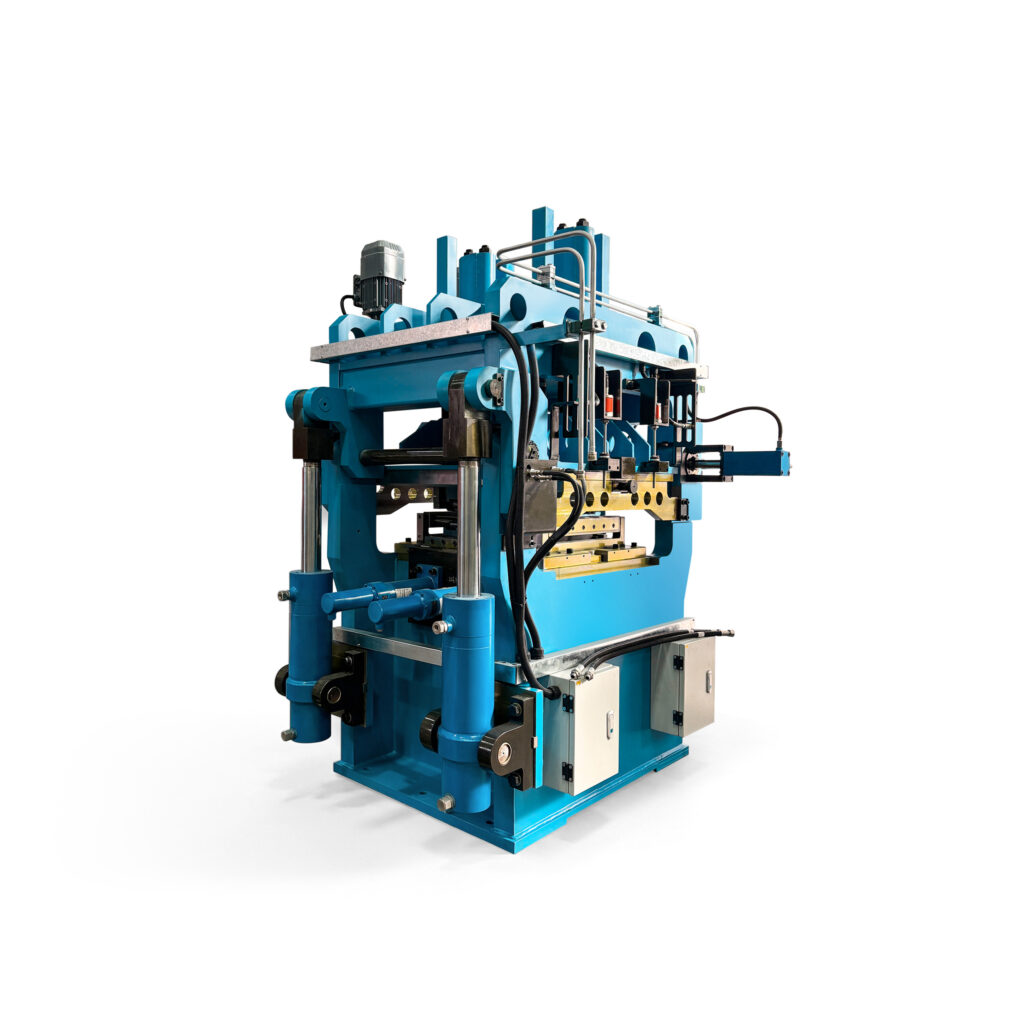
This is where Chinese OEMs such as ASCON have a clear opening. ASCON’s Tension Leveling Equipment product line already addresses the core functional requirement: eliminating three-dimensional shape defects through a combination of tension rolls and alternating bending components. Its roll cassette systems deliver dimensional tolerances within ±0.05 mm and are rated for dynamic loads up to 8 tons, with modular designs that reduce maintenance downtime by up to 60%. These are not trivial capabilities—they represent the building blocks of a competitive SBL solution.
The strategic path for Chinese OEMs is not to replicate b+s’s complete line immediately. Instead, they should focus on modular units: a high-tension straightening unit optimized for titanium strip deformation characteristics, or a micro-tension control system for ultra-thin gauge materials. By first becoming qualified suppliers for domestic titanium and specialty alloy lines, and accumulating process data across diverse material grades, Chinese OEMs can build the engineering foundation needed to compete at the system level.
4. A Window , Not a Certainty
The Ulbrich–b+s deal confirms that superimposed tension technology is the benchmark for specialty alloy leveling. China’s expanding cold-rolling capacity for titanium and nickel-based alloys creates genuine demand pull for domestically sourced finishing equipment.
The 35% import dependency in high-end titanium strip is both a problem and a market signal for domestic Tension Leveling Equipment. The window is open—but only for OEMs willing to invest in material-specific process know-how rather than generic leveling solutions.
- Topics You may Be Interested In:
- Tension Leveler
- Multi-roll Leveler
- Scale breaker
- Work Roll
- Back up roll