Steel mill and processing plant buyers struggle with expensive imported rollers. We analyze whether high-performance Chinese rubber covered rolls balance quality, service life and cost, combining data from authoritative Chinese metallurgy & rubber technical journals.
For metallurgical factories, continuous printing lines and material processing manufacturers, rubber covered rolls are irreplaceable consumable spare parts. These components undertake material transportation, compression and surface protection tasks. For decades, many production operators chose European, American and Japanese imported rollers to guarantee stable running. However, soaring procurement costs, long delivery lead times and complicated after-sales channels force purchasing managers to rethink their sourcing strategy.
A core question emerges: Can high-performance Chinese-manufactured rubber covered rolls serve as a reliable alternative to cut annual spare parts expenditure without sacrificing production stability? This article combines practical field operation data and research conclusions published in China’s authoritative technical journals to deliver objective comparison and actionable selection advice.
- Performance Gap: Premium ChineseRubber Covered Roll vs Imported Products
Many plant managers hold the stereotype that Chinese covered rollers always lag behind imported counterparts. Industry research breaks this view, yet quality differentiation inside Chinese manufacturers cannot be ignored.
As documented in Rubber Industry, China’s core monthly technical journal focused on rubber composite materials, the bonding performance between rubber cladding and steel core determines the overall service cycle of rubber covered rolls.
Shot blasting pretreatment, specialized primer coating and controlled vulcanization are three indispensable procedures to avoid delamination. Qualified Chinese manufacturers strictly implement standardized processing, enabling the bonding layer to withstand shear force exceeding 15 MPa, fully meeting ASTM D429 adhesion testing standards. In contrast, low-cost inferior rollers skip surface pretreatment, leading to rapid separation between rubber and steel core under alternating temperature and load.
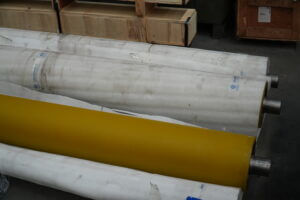
Our rubber covered rolls adopt self-developed reinforced rubber formulations. Laboratory verification shows the service lifespan can be extended by 30–50% compared with ordinary low-standard covered rollers. The friction coefficient stabilizes within 0.6–1.2 μ, effectively preventing scratches on polished metal strips, glass panels and composite materials.
From the metallurgical application perspective, case studies published in Steel Rolling, a bimonthly journal specializing in strip processing and galvanizing line technology, point out that defective covered rollers are one hidden cause of metal strip surface scratches, strip deviation and unstable flatness on continuous galvanizing lines.
Top-tier Chinese rubber covered rolls adopt multi-step precision machining, supporting dimensional specifications ranging from 25 mm to 1500 mm in diameter and maximum length up to 6000 mm. Available hardness covers 20°–95° Shore A (tested per ASTM D2240). Multiple material options including NBR, EPDM, SBR and FKM satisfy oil-resistant, heat-resistant and anti-static working requirements, reaching equivalent operational performance of mainstream imported rollers under identical galvanizing and metal processing conditions.
Notably, the performance gap mainly exists between low-grade Chinese rollers and imported brands. Once manufacturers own complete quality control systems and standardized vulcanization workshops, the technical disparity is greatly narrowed..
- Comprehensive Cost Comparison: Initial Purchase & Long-Term Operating Expense
Total ownership cost rather than unit price should be the primary measurement standard for spare part procurement.
Original imported rubber covered rolls carry extremely high unit prices. High-performance Chinese rubber covered rolls can lower one-off procurement expenditure significantly. Meanwhile, imported orders usually face long lead cycles: production, ocean shipping, customs clearance and inland transportation generally take 8–16 weeks. Once spare parts run out unexpectedly, factories confront risks of unplanned production shutdown and massive economic losses.
According to market analysis reports issued by China Rubber monthly journal and China Rubber Industry Association, leading Chinese rubber covered roll suppliers maintain stock of regular specifications and support fast shipment. In addition to brand-new rollers, qualified Chinese factories supply roller re-coating and renovation services. Old steel cores can be reused after re-cladding, further cutting long-term spare parts investment for metal processing plants.
Many overseas galvanizing and steel strip manufacturers overlook hidden costs of cheap low-quality rollers: frequent replacement shutdowns, higher reject rate of finished metal products, and additional maintenance labor expense. Cost advantages only take effect when factories select standardized, fully inspected high-performance Chinese suppliers.
- Delivery Flexibility & Technical Customization Advantages
Customization demands become increasingly common for modern metal processing production lines. Factories require tailored hardness, surface finish (smooth, grinded, ribbed, grooved) and special temperature-resistant formulas to match unique working environments.
Most overseas original equipment suppliers set rigid customization thresholds with prolonged development cycles. In contrast, professional Chinese manufacturers offer flexible customized solutions. Engineers can select suitable cladding materials according to working temperature range (-60°C ~ +300°C), chemical medium and load conditions.
Our internal laboratory executes complete batch testing for hardness, radial runout and bonding strength before delivery. Full product traceability and official inspection documents can be provided, consistent with international testing standards widely recognized by global steel mills.
- How to Choose Reliable ChineseRubber Covered Roll Suppliers
Switching to Chinese alternatives does not mean blindly pursuing the lowest price. We summarize key screening criteria referenced by technical papers from China’s industrial periodicals:
- Complete production chain: Self-owned workshop covering steel core processing, surface pretreatment, vulcanization and precision grinding;
- Independent laboratory: Conduct routine tests following ASTM D2240, ASTM D429 and ASTM D471 standards;
- Clear material documentation: Offer material data sheets for NBR, EPDM, FKM and other elastomer options;
Support roller renovation service, rather than only selling brand-new products;
Supply verified application cases on galvanizing lines, rolling mills and continuous processing equipment.
- Suitable Scenarios for Adopting Chinese High-Performance Rubber Covered Rolls
✅ Recommended to select premium Chinese rubber covered rolls if:
You aim to reduce annual spare parts budget without compromising production stability;
Fast delivery and emergency stock support are required to avoid line halt;
You need flexible technical customization and rapid local after-sales communication;
Existing rollers can be renovated via re-coating to reuse steel cores.
✅ Retain imported rollers only if:
Your production line has exclusive OEM binding requirements;
Extremely special customized specifications cannot be matched by qualified Chinese manufacturers.
Conclusion
Supported by continuous material and process innovation, high-performance Chinese rubber covered rolls have become a viable alternative to imported rollers for most metal processing and galvanizing production lines. When buyers cooperate with formal, quality-controlled manufacturers, they can achieve balanced benefits: equivalent operational performance, lower procurement expense and shorter delivery cycles.
As industrial research in Rubber Industry and Steel Rolling repeatedly confirms, the core selection principle is not simply “import versus Chinese”, but verifying the supplier’s manufacturing process, quality inspection system and field application track record.
If you are sourcing durable rubber covered rolls for metal processing or continuous galvanizing lines, contact us to acquire technical datasheets, hardness selection guides and factory quotations.