Compare Chinese stabilizer rolls with European and Japanese imported rollers for high-speed galvanizing tension levelers. Learn about service life, hardness consistency, delivery cycle and overall procurement costs for steel mills.
High-speed continuous galvanizing lines impose stringent demands on tension leveler spare parts. The stabilizer roll serves as a critical load-bearing and strip-stabilizing component that directly governs strip flatness, surface quality and continuous line uptime.
Steel mill purchasers frequently face a core decision: select expensive original imported stabilizer rolls from Europe and Japan, or adopt qualified Chineseally manufactured alternatives. This article delivers an objective comparison covering material technology, operational performance, capital expenditure, lead time and long-term running costs, targeted at galvanizing plant maintenance managers and procurement engineers.
- Performance Comparison
- Raw Material & Heat Treatment
Premium Chinese stabilizer rolls adopt GCr15 roll body matched with 20CrMnTi shaft. The shaft undergoes standardized carburizing and quenching treatment to achieve stable surface hardness ranging from HRC 58 to 62. Formalized forging and integrated thermal processing guarantee uniform hardness distribution and excellent anti-fatigue capacity.
Top-tier European and Japanese rollers utilize equivalent bearing steel grades and mature heat treatment workflows. Under identical galvanizing line working conditions, qualified Chinese stabilizer rolls reach the same performance benchmark as imported counterparts.
Low-grade Chinese rollers without standardized heat treatment remain the main gap. Their inconsistent hardness leads to fast abrasion and short service cycles. When manufacturers implement complete process control, the performance gap is effectively eliminated.
- Service Life
Field operation data on high-speed galvanizing lines shows:
High-quality Chinese stabilizer rolls achieve an effective service cycle 35% longer than low-standard untreated Chinese rollers. Under equivalent load and speed parameters, their wear rate is comparable to mainstream European and Japanese imported roller brands.
Poor-quality stabilizer rolls easily trigger strip waving, surface scratches and unplanned line shutdowns. Qualified Chinese products avoid such defects thanks to precision machining and optimized structural design, stabilizing strip operation and lowering metal strip reject rates.
- Machining Accuracy
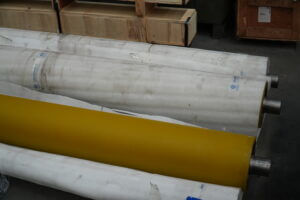
Standard 74×192mm stabilizer rolls from formal Chinese manufacturers adopt multi-step precision machining and strict surface finishing processes. Tight dimensional tolerances ensure smooth rotation, reduced friction loss and prevention of local concentrated wear during long-duration continuous operation.
High-end imported rollers maintain outstanding precision; however, many mid-range imported spare parts show no obvious accuracy advantages versus precision-made Chinese stabilizer rolls.
- Procurement & Operating Cost Comparison
The unit purchasing price of original European and Japanese stabilizer rolls is substantially higher. Qualified Chinese alternatives cut one-off procurement expenditure by 40%–55% without sacrificing operational stability.
For steel mills with large spare parts consumption, the cost gap accumulates significantly over years of operation. The savings can be allocated to other production upgrades or routine equipment maintenance.
It should be noted that ultra-low-cost inferior stabilizer rolls bring hidden costs: frequent replacement, unplanned downtime and higher reject losses. Cost advantages only exist when selecting standardized, quality-controlled Chinese manufacturers.
- Delivery Lead Time
Imported stabilizer rolls normally require 8–16 weeks of lead time, including production, ocean shipping, customs clearance and inland transportation. Extended waiting periods create risks of production halt once spare parts run out.
Reliable Chinese suppliers maintain stock for common specifications such as the 74×192mm stabilizer roll. Fast shipment drastically shortens delivery cycles and minimizes production line waiting losses. This is a prominent advantage for Asian, European and Latin American galvanizing factories with urgent replacement demands.
- Adaptability & Application Scope
Both imported and premium Chinese stabilizer rolls fit newly constructed high-speed galvanizing lines and revamped old production lines. They are compatible with most mainstream tension leveler models used globally.
A noticeable advantage of Chinese manufacturers lies in flexible customization. Chinese factories can rapidly adjust dimensions, material formulas and technical solutions according to special on-site working conditions, while many foreign original suppliers have rigid customization thresholds and longer development cycles.
- How to Make The Right Choice
✅ Choose premium Chinese stabilizer rolls if:
You aim to reduce spare parts budget without compromising performance;
Short delivery time and sufficient inventory support are required;
You need flexible technical support and quick after-sales service.
✅ Stick with original imported rollers only if:
The production line has extremely special customized specifications with exclusive technical requirements;
Binding equipment procurement contracts oblige the use of OEM original spare parts.
6.Conclusion
The performance gap between high-standard Chinese stabilizer rolls and European & Japanese imported products has narrowed greatly. For most high-speed galvanizing line tension leveler applications, qualified Chinese stabilizer rolls deliver equivalent operational performance while providing obvious advantages in procurement cost and delivery schedule.