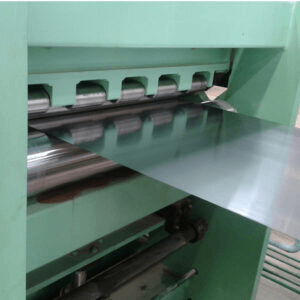
For plant‑operation managers and procurement teams running wide‑strip galvanizing lines, the two‑bending & two‑levelling dry‑type tension straightener delivers powerful flatness correction for strip widths up to 2700 mm. Nevertheless, field‑operating defects still emerge when handling 0.15‑4.0 mm carbon steel, stainless steel and aluminum strip.
As documented in metallurgical journal research, typical failures including surface color aberration, periodic roll marks, failure to hit target flatness of 3‑5 I, and unexpected strip breakage are rarely caused by equipment hardware defects alone. Most issues originate from incoming‑strip status, improper tension setup, roll‑surface degradation and non‑standard roll‑changing workflows. Understanding these root causes helps reduce scrap rate and unplanned downtime for continuous galvanizing production.
Surface color aberration and periodic roll marks are frequent visual defects observed after tension‑straightening processing. Color aberration presents as inconsistent brightness across strip width. According to journal analysis, uneven friction transfer between work rolls and strip surface is the main trigger, which is aggravated by residual particles from upstream rolling sticking onto roll surfaces. Roll‑mark defects show periodic stripes matching work‑roll circumference, usually generated by local scratches, dents or uneven roughness on leveling rolls. For wide‑format strips processed by two‑bending & two‑levelling units, uneven load distribution across roll length accelerates partial roll‑surface wear. Without regular inspection and grinding, contaminated or damaged rolls will continuously imprint defects on passing strips, directly downgrading galvanized finished goods.
Another common pain point is finished‑strip flatness failing to reach the target 3‑5 I, even after full‑unit commissioning. The two‑bending two‑levelling layout is engineered to correct incoming flatness within 30‑50 I, yet unsatisfactory outcomes frequently occur under actual production.
Inappropriate tension‑force setting is the primary factor: insufficient tension cannot generate enough plastic elongation, while excessive intermesh setting brings extra local stress. Poor‑quality incoming coils with fluctuating flatness also exceed the correction window. For wide strip near 2700 mm width, uneven transverse load on dual‑bending modules will leave residual edge‑wave or central‑buckle, which cannot be completely eliminated only by later‑stage galvanizing‑line adjustments.
Unexpected strip breakage during high‑speed operation brings severe loss for galvanizing lines running up to 600 m/min. Strip fracture mostly takes place at weld joints or sections with material inclusions.
Over‑tension parameters set for wide‑specification material amplify internal stress. Besides process‑parameter deviation, worn roll surfaces with sharp scratches can cut strip edges during bending deformation, triggering sudden break‑off and forced‑line shutdown. Frequent strip breakage not only creates mass scrap, but also imposes impact damage on bending and leveling roll assemblies.
Many of these defects and shutdown events relate directly to roll‑exchange workflows. Manual roll‑changing for two‑bending two‑levelling wide‑strip units consumes long downtime. During repeated disassembly and assembly, improper handling may scratch roll surfaces or cause misalignment of bending modules, introducing new failure sources for subsequent batches.
This is where the optional hydraulic roll‑change device delivers tangible operational value. It supports fast cassette‑style roll replacement with precise positioning, largely avoiding man‑made surface damage and alignment errors. Switching among different strip thickness and width specifications can be finished within much shorter cycles, cutting unplanned downtime and lowering the probability of roll‑induced surface defects.
Plant teams should match preventive maintenance with parameter calibration: monitor roll‑surface status regularly, keep tension and intermesh within material‑specific windows, and evaluate the necessity of hydraulic roll‑change configuration for frequent‑spec‑switch production scenarios. Selecting well‑matched hardware and standardized operation will unlock the full correction potential of the two‑bending & two‑levelling tension straightener for new‑energy‑grade wide metal strip.
Please visit our product details page; we can provide customized services tailored to your specific needs.Tension Leveler
References
‑ Yang J, Cheng Z Z, Hu Q, et al. Analysis and optimization about color aberration of strip steel in galvanizing and tension leveler unit[J]. Journal of Iron and Steel Research, 2017, 29(9):739‑748.http://www.chinamet.cn/Jweb_gtyjxb_cn/EN/10.13228/j.boyuan.issn1001-0963.20160306